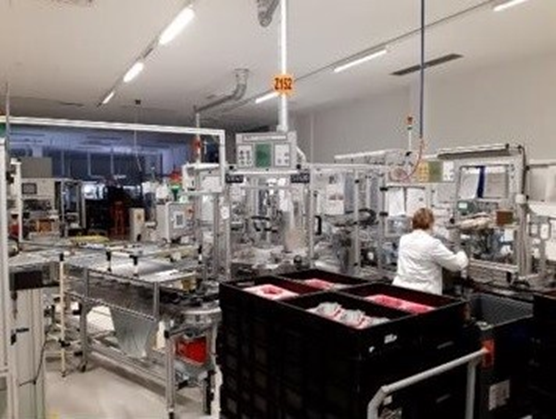
MAHLE Electric Drives Slovenija d.o.o., headquartered and operating production facilities in Šempeter pri Gorici, is part of the global MAHLE GmbH group based in Stuttgart. The company is an internationally recognised manufacturer of starters and alternators for internal combustion engines, self-powered DC electric drive systems and other advanced components for the automotive industry.
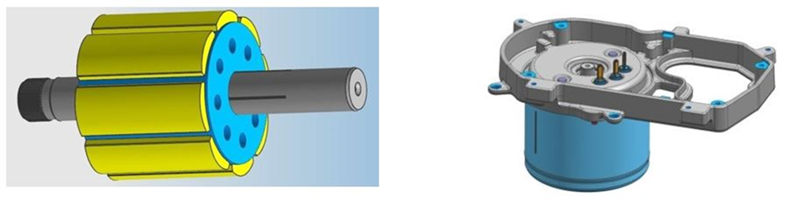
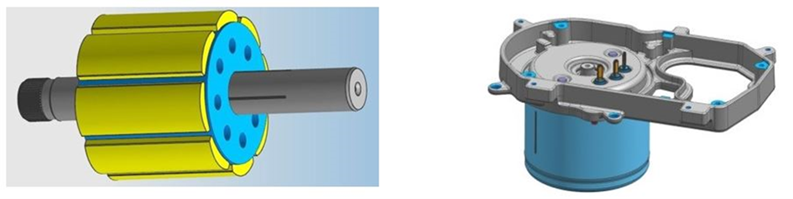
In the development of its products, the company uses state-of-the-art approaches and cooperates with research institutions. This was also the case in the project involving the development of a synchronous electric motor with surface-mounted magnets, intended as part of an automotive power steering system. The objective of the project was the techno-economic optimisation of the electric motor, namely to determine the geometry and material properties of its components in such a way that the electric motor meets all technical requirements while keeping its cost as low as possible.
The solution was developed in cooperation with researchers from the Department of Intelligent Systems and the Department of Computer Systems at the Jožef Stefan Institute. The company and researchers were supported by the Institute’s Project Content Support, Technology Transfer and Innovation Office, as well as the Office for Cooperation with Industry. These teams initially identified the company’s key technological and development challenges and then established contact with the two research departments based on their expertise and knowledge required to develop a company-specific technological solution. They also supported the researchers in preparing possible approaches and methods for addressing the company’s technological challenge, including negotiations, formal aspects of establishing cooperation and issues related to intellectual property.
As part of the cooperation, a computer-supported iterative optimisation procedure was developed and connected to a numerical simulator of possible solutions based on the finite element method. A key challenge was the high computational complexity of the simulations and, consequently, of the entire optimisation procedure. The procedure was therefore upgraded with several acceleration techniques, including rapidly computable surrogate models, parallelisation of the optimisation algorithm and multi-step evaluation of solutions, which made it possible to eliminate certain infeasible solutions without the need for computationally demanding simulations.
Another challenge was the need to ensure the robustness of the solution while taking into account manufacturing tolerances in electric motor production. This was achieved by evaluating feasible solutions within the optimisation procedure on a sample of variants with different deviations. Finally, in addition to numerical results, the project team also wanted to gain insight into the space of possible solutions and thereby achieve a better understanding of the problem. This was accomplished by integrating data analysis and visualisation methods into the optimisation environment.
The development of the solution required the participating researchers to apply expertise in metaheuristic optimisation methods with surrogate models, computationally intensive procedures, and data analysis and visualisation. The project team members from the company contributed their knowledge of electric motors and their design, provided the starting points for the optimisation procedure, and supplied the software and licences for calculating the electromagnetic model using the finite element method.
The result of the cooperation was the electromagnetic design of the active parts of the electric motor, defined by the values of its dimensional and material parameters. The obtained parameter values ensure the rational use of components, the highest possible fulfilment of customer requirements regarding the characteristics of the electric motor, and cost-effectiveness. Compared with the initial version, the optimised electric motor has a 10% lower component cost. Given that several million units of such a product are produced over the entire production period, this represents a significant saving for the company and greatly improves its competitiveness in the market.
For this achievement, MAHLE Electric Drives Slovenija d.o.o. and the Jožef Stefan Institute received the TARAS award at the IRT Industrial Forum 2023 in Portorož for successful cooperation between industry and the research and development environment in the fields of innovation, development and technology.
The project was directly financed by MAHLE Electric Drives Slovenija d.o.o. The Project Content Support, Technology Transfer and Innovation Office, together with the Office for Cooperation with Industry at the Jožef Stefan Institute, played a key role in establishing the cooperation.